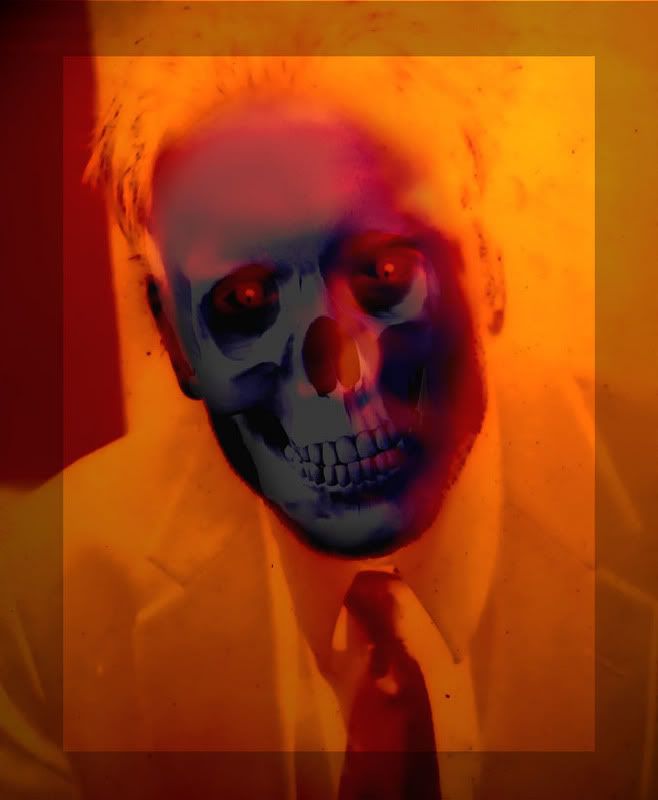
(This Article was featured as an opinion piece in the November 2006 issue of the Mount Observer.)
Two men burn while impaled on individual stakes somewhere within the deepest layer of Hell. One, a Fundamentalist Muslim Jihadist donned in traditional Islamic garb and garlanded with an AK-47 bandolier. His equally fated partner, an unusual bedfellow of condemnation, a Fundamentalist Christian Armageddonist conservatively dressed in a business suit; hair immaculately styled the Executive cut.
Both engage in a heated argument, ranging periodically from haughty tones to snapping rage bursts, unfazed by the unrelenting flames that char their flesh to carbon dust... dark as sin... that melt away and dissipates from gristled bones.
"You have been warned, Infidel. When Allah finally rewards my exalted deed in Janna, you'll regret your allegiance with the Great Satanic Empire of the West.” chided one who apparently defines his “exalted deed” with suicide bombing a bus load of Peace Corps activists, with no intent nor affiliation outside unconditional philanthropy.
“Hah!!!” blurted his equally self-righteous counterpart with a belittling scoff. “Once Jesus returns on his day of Rapture to Judge the wicked, my soul will inherit everlasting life in Heaven...and YOU will be forever punished for engaging in a barbarically violent, pagan religion!!!” Aside from his exhaustive time with the “Life and Family Values” religious organization he assisted in its founding, he funded the costs by war profiteering the latest in “smart weaponry” technology that somehow mistaken an understaffed and short supplied children's hospital as an insurgent ammunitions cache.
Both men fail to realize the irony of their shared situation...
Tuesday, November 25, 2008

The Questions of Censorship Within the College Atmosphere
(This article was written in March 2006 with intent for publishing in the Mount Observer. It was declined due to lack of space. )
Several years ago, an incident occurred where a student had made a request to ban a particular book available for public reading at the Mount Wachusett Community College Library. For whatever motivations this undisclosed student may have had, be it religious or political, the reasons recalled by Library Director Linda Oldach were that the book contained “child pornographic” photos.
This book, entitled Playing with the Edge by Arthur Danto, is a critical assessment of Robert Mapplethorpe's achievement as an photographic artist. Ironically enough, this book focuses on the controversy that had taken momentum almost two decades ago when Mapplethorpe's Artwork, primarily depicting homoeroticism and sado-masochistic situations, was displayed through government funding from the National Endowment for the Arts. The overall question concerning the nature of Mapplethorpe's photography was “Should either the general public or its representing government have consent to whom is allowed financial support based on content potentially deemed pornographic or obscene?”
Despite the claims of pedophilia, attempts to rid this book from the school library proved inconsequential as it remains today for any and all to read. Upon inspection, one may find two enclosed photographs possibly relevant to the student's protesting claim; one photograph titled “Rosie” is of a preschool girl wearing a sun-dress and sitting in such a manner that incidentally reveals her vulva, and the other photograph titled “Jesse McBride” is of a young boy also sitting but completely nude and frontally exposed.
Regardless of subject preference, neither photographs bear any intended sexual innuendo nor had both models been apparently situated in any perverse setting. More importantly, neither model was reported molested. According to Danto, the boy model, now a young man, Jesse Mcbride had been asked of his feelings towards his experience fourteen years later to which he replied he “felt no untoward effects.”
From my own assessment, the children appear to me as oblivious to the moral platitude society bears upon nudity as those with children of their own would expect, witnessing the highly common habit of young ones running about naked or unaware of appropriate posturing in potentially revealing clothing articles.
Those familiar with Mapplethorpe's work and expression thereof understand that although most of his photography could be considered erotic in one sense or another, many pieces were not deemed sexually appealing to Mapplethorpe himself. The intention of his artwork was to expand the concept of human sexuality or to redefine our attitude towards supposed perversions when seen as natural inclinations and happenings.
When considering Mapplethorpe's intention to simply capture a moment presenting itself and the children unaware of the implications from others seeing them as they are, one must begin to wonder just how much of this proposed obscenity had been influenced by the witnesses themselves. Would these photographs remain as pedophilia if the viewer had no sexual thoughts associated with the images?
So here lies the argument: To what extent can one freely express himself and equally how much is one expected to tolerate those who challenge moral standards through ambiguous media?
“With my job comes a serious responsibility to select quality information for public and academical interest,” said Ms. Oldach. “Yet I must consider cases of objection based upon valid arguments from reliable sources.”
All members of faculty and student body alike are allowed the privilege of challenging content provided by the college library, by filling out a form called a Request for Reconsideration of Library Materials which asks for a full description of the work, your reasons why you chalenged said materials, if you had viewed the entire source for credibility purposes, and if you'd prefer to recommend any balancing material over outright banning of the work in question.
Although a student or faculty member may reserve the right to challenge any library content, the censoring process is far from automatic. The next procedure requires the Assistant Dean of Library and Information Services to consider the objection without infringement of the first article of the Library Bill of Rights of the American Library Association, which states, “Libraries should provide materials and information presenting all points of view on current and historic issues. Materials should not be proscribed or removed because of partisan or doctrinal disapproval.”
When asked what her personal stance was with those seeking to censor literary materials based upon disagreement of perception and values, Linda Oldeck responded, “Regarding this particular case, I find that Mapplethorpe doesn't reflect my tastes, but it is my principle never to interfere with another's right to artistic expression.”
Several years ago, an incident occurred where a student had made a request to ban a particular book available for public reading at the Mount Wachusett Community College Library. For whatever motivations this undisclosed student may have had, be it religious or political, the reasons recalled by Library Director Linda Oldach were that the book contained “child pornographic” photos.
This book, entitled Playing with the Edge by Arthur Danto, is a critical assessment of Robert Mapplethorpe's achievement as an photographic artist. Ironically enough, this book focuses on the controversy that had taken momentum almost two decades ago when Mapplethorpe's Artwork, primarily depicting homoeroticism and sado-masochistic situations, was displayed through government funding from the National Endowment for the Arts. The overall question concerning the nature of Mapplethorpe's photography was “Should either the general public or its representing government have consent to whom is allowed financial support based on content potentially deemed pornographic or obscene?”
Despite the claims of pedophilia, attempts to rid this book from the school library proved inconsequential as it remains today for any and all to read. Upon inspection, one may find two enclosed photographs possibly relevant to the student's protesting claim; one photograph titled “Rosie” is of a preschool girl wearing a sun-dress and sitting in such a manner that incidentally reveals her vulva, and the other photograph titled “Jesse McBride” is of a young boy also sitting but completely nude and frontally exposed.
Regardless of subject preference, neither photographs bear any intended sexual innuendo nor had both models been apparently situated in any perverse setting. More importantly, neither model was reported molested. According to Danto, the boy model, now a young man, Jesse Mcbride had been asked of his feelings towards his experience fourteen years later to which he replied he “felt no untoward effects.”
From my own assessment, the children appear to me as oblivious to the moral platitude society bears upon nudity as those with children of their own would expect, witnessing the highly common habit of young ones running about naked or unaware of appropriate posturing in potentially revealing clothing articles.
Those familiar with Mapplethorpe's work and expression thereof understand that although most of his photography could be considered erotic in one sense or another, many pieces were not deemed sexually appealing to Mapplethorpe himself. The intention of his artwork was to expand the concept of human sexuality or to redefine our attitude towards supposed perversions when seen as natural inclinations and happenings.
When considering Mapplethorpe's intention to simply capture a moment presenting itself and the children unaware of the implications from others seeing them as they are, one must begin to wonder just how much of this proposed obscenity had been influenced by the witnesses themselves. Would these photographs remain as pedophilia if the viewer had no sexual thoughts associated with the images?
So here lies the argument: To what extent can one freely express himself and equally how much is one expected to tolerate those who challenge moral standards through ambiguous media?
“With my job comes a serious responsibility to select quality information for public and academical interest,” said Ms. Oldach. “Yet I must consider cases of objection based upon valid arguments from reliable sources.”
All members of faculty and student body alike are allowed the privilege of challenging content provided by the college library, by filling out a form called a Request for Reconsideration of Library Materials which asks for a full description of the work, your reasons why you chalenged said materials, if you had viewed the entire source for credibility purposes, and if you'd prefer to recommend any balancing material over outright banning of the work in question.
Although a student or faculty member may reserve the right to challenge any library content, the censoring process is far from automatic. The next procedure requires the Assistant Dean of Library and Information Services to consider the objection without infringement of the first article of the Library Bill of Rights of the American Library Association, which states, “Libraries should provide materials and information presenting all points of view on current and historic issues. Materials should not be proscribed or removed because of partisan or doctrinal disapproval.”
When asked what her personal stance was with those seeking to censor literary materials based upon disagreement of perception and values, Linda Oldeck responded, “Regarding this particular case, I find that Mapplethorpe doesn't reflect my tastes, but it is my principle never to interfere with another's right to artistic expression.”
A Fair Warning To Our Readers, Student or Faculty
I was again asked by the Chief Editor of the Mount Observer to write an editorial in response to one of the most heinous acts of vandalism or possibly censorship ever commited upon our published materials. It was featured in the September 2007 issue. Consequently, it was also my last published article in the Mount Observer due to conflicts of disposition with the student newspaper's advisor over this very controversy. There were a few strong leads suggesting that the College President may have personally thrown away an estimated 90 percent of the entire batch of the May 2007 issue. (which coincidently occurred one day before Governor Deval Pratrick was scheduled to speak during the 2007 graduation ceremony, and also featured my editorial which was strongly critical of the president.) However, my strong leads were suppressed and I was accused of brazen, irresponsible judgement by my advisor...which in turn I accused of cowardice.
In the morning of May 17, the day that Massachusetts Governor Deval Patrick spoke amongst the 2007 student graduates of our beloved community college, out of nine Mount Observer newspaper bins, all but one was emptied and later found thrown into various recycle bins.
The chance to display the quality of writing from those participating student journalists was ruined, and those who had attended the commencement ceremony, including our state governor himself , were denied access to potentially valuable information regarding our school; Information that had taken the entire staff of volunteer journalists, photographers, paid advertisers, editors, and printers a month-long effort to create, prepare, and deliver.
Although suspicions have not been confirmed beyond a reasonable doubt as to who was the culprit, or even if foul play was the motive, the entire staff of the Mount Observer feels we must take this time to address the issue of censorship and newspaper theft, in order to deter such future acts of possible suppression of free speech, vandalism, or gross negligence.
According to the Student Press Law Center, a legal organization dedicated to the provisions and support for the rights of student journalists, public college and university publications are protected under the First Amendment from any government censorship. Student Journalists cannot be coerced into press regulation, subjected to prior review, disciplined for unpopular submissions, removed from position, or denied funds based on content.
If the motive is simple theft or vandalism, be warned that a free newspaper does not give a single group or individual the right to steal, deface, or remove large quantities of its publication. Our full intention is to allow all students the right and privilege to read it, so we allow one free paper per student, and we have every right to charge any monetary value for each additional copy taken, so long as it is clearly printed within our publication's masthead.
Be also warned that we have every right to take legal action, notify law enforcement, press charges, and tally the total loss according to the total number of papers stolen or destroyed, its printing and delivery costs, refunded revenue in advertising, salary paid to staff, telephone and postage expenses, and various materials consequently wasted which could bring the total to thousands of dollars.
Will we enforce a draconian policy if a student wishes to take several copies for friends and family? Hardly. We are reasonable and wish only to satisfy our readers. However, we feel we were wronged once already, with almost 90% of our May issue needlessly destroyed. Whether it was intentionally malicious or just simply ignorant, such losses will never happen again without serious repercussions to all guilty parties. We promise.
In the morning of May 17, the day that Massachusetts Governor Deval Patrick spoke amongst the 2007 student graduates of our beloved community college, out of nine Mount Observer newspaper bins, all but one was emptied and later found thrown into various recycle bins.
The chance to display the quality of writing from those participating student journalists was ruined, and those who had attended the commencement ceremony, including our state governor himself , were denied access to potentially valuable information regarding our school; Information that had taken the entire staff of volunteer journalists, photographers, paid advertisers, editors, and printers a month-long effort to create, prepare, and deliver.
Although suspicions have not been confirmed beyond a reasonable doubt as to who was the culprit, or even if foul play was the motive, the entire staff of the Mount Observer feels we must take this time to address the issue of censorship and newspaper theft, in order to deter such future acts of possible suppression of free speech, vandalism, or gross negligence.
According to the Student Press Law Center, a legal organization dedicated to the provisions and support for the rights of student journalists, public college and university publications are protected under the First Amendment from any government censorship. Student Journalists cannot be coerced into press regulation, subjected to prior review, disciplined for unpopular submissions, removed from position, or denied funds based on content.
If the motive is simple theft or vandalism, be warned that a free newspaper does not give a single group or individual the right to steal, deface, or remove large quantities of its publication. Our full intention is to allow all students the right and privilege to read it, so we allow one free paper per student, and we have every right to charge any monetary value for each additional copy taken, so long as it is clearly printed within our publication's masthead.
Be also warned that we have every right to take legal action, notify law enforcement, press charges, and tally the total loss according to the total number of papers stolen or destroyed, its printing and delivery costs, refunded revenue in advertising, salary paid to staff, telephone and postage expenses, and various materials consequently wasted which could bring the total to thousands of dollars.
Will we enforce a draconian policy if a student wishes to take several copies for friends and family? Hardly. We are reasonable and wish only to satisfy our readers. However, we feel we were wronged once already, with almost 90% of our May issue needlessly destroyed. Whether it was intentionally malicious or just simply ignorant, such losses will never happen again without serious repercussions to all guilty parties. We promise.
A Question for President Asquino: Do You Think We’re Second-Rate?
I was asked by the chief editor to write up an editorial in response to the Mount Wachusett Community College President's decline for questioning due to "lack of time." It seemed to me that I was the only one who dared to publicly challenge the president's actions and decision-making. Several others within the staff expressed fear of possible reprocussions. It was given front-page staus in the May 2007 issue of the Mount Observer.
Mr. president,
Perhaps you may remember an email we have sent you, addressed from the Mount Observer and dated Tuesday, April 17, twenty minutes past noon. To refresh your memory, we’re referring to the one in which you replied less than an hour later.
It was only one day after Cho Sueng-Hui gunned down thirty-two students and faculty, then himself, within the Virginia Tech campus and we felt it was necessary to address concerns of safety measures or emergency procedures that have either been established to at least discussed for our college, within her own newspaper.
Out of respect, Mr. President, we had sent you five questions concerning what our student body should know or how they should proceed if a similar tragic incident were to ever occur here, following with four personal questions asking for your professional opinion and intimate feelings on this matter. If you remember, Mr. President, your reply was simply a courteous “Thank you,” then requested we discuss this with Chief Kolimaga.
We understand that a man of your position is frequently busy with important and time-sensitive affairs, as we had acknowledged this within our email’s conclusive paragraph, so we remained sympathetic, however disappointed, up until three days later when we had stumbled upon an surprising article laid out upon the front page of the April 19 issue of the Gardner News.
The topic of this surprising, front-page article was very familiar to the one we, here at the Mount Observer, desired to cover for our May issue. What made it even more surprising is that it consisted primarily of comments and opinions from you, Mr. President: exactly five quotes and paraphrases each.
As active reporters ourselves, we understand that in order to obtain ten paragraphs of reported material from one source requires a substantially lengthy interview, one that would require much more time than we had previously assumed you couldn’t spare.
Need I remind you, Mr. President, that we are the printed voice of our college’s student body, consisting of articles covered by said student body, concerning issues that directly affect the student body, like the one that addressed our safety if ever confronted by one disgruntled and armed to the teeth.
Somehow, an outside newspaper, whose name we need not to mention again, received cooperation from our own president yet no similar article will appear in this issue due to lack of compliance from reliable sources… with only an editorial to take its place.
We believe it is fair to say that we have cooperated with faculty and administrators in the past when it came to press releases, but as students who desire the experience and especially eventual careers in journalism, we require a little more than secretarial work. We have ideas of our own to publish in the Mount Observer and really need the cooperation of all who roam within the limits of our beloved campus; it’s all we have in comparison to other newspapers whose reporting privileges expand an entire multi-town district.
Sincerely,
The Editors of the Mount Observer
Mr. president,
Perhaps you may remember an email we have sent you, addressed from the Mount Observer and dated Tuesday, April 17, twenty minutes past noon. To refresh your memory, we’re referring to the one in which you replied less than an hour later.
It was only one day after Cho Sueng-Hui gunned down thirty-two students and faculty, then himself, within the Virginia Tech campus and we felt it was necessary to address concerns of safety measures or emergency procedures that have either been established to at least discussed for our college, within her own newspaper.
Out of respect, Mr. President, we had sent you five questions concerning what our student body should know or how they should proceed if a similar tragic incident were to ever occur here, following with four personal questions asking for your professional opinion and intimate feelings on this matter. If you remember, Mr. President, your reply was simply a courteous “Thank you,” then requested we discuss this with Chief Kolimaga.
We understand that a man of your position is frequently busy with important and time-sensitive affairs, as we had acknowledged this within our email’s conclusive paragraph, so we remained sympathetic, however disappointed, up until three days later when we had stumbled upon an surprising article laid out upon the front page of the April 19 issue of the Gardner News.
The topic of this surprising, front-page article was very familiar to the one we, here at the Mount Observer, desired to cover for our May issue. What made it even more surprising is that it consisted primarily of comments and opinions from you, Mr. President: exactly five quotes and paraphrases each.
As active reporters ourselves, we understand that in order to obtain ten paragraphs of reported material from one source requires a substantially lengthy interview, one that would require much more time than we had previously assumed you couldn’t spare.
Need I remind you, Mr. President, that we are the printed voice of our college’s student body, consisting of articles covered by said student body, concerning issues that directly affect the student body, like the one that addressed our safety if ever confronted by one disgruntled and armed to the teeth.
Somehow, an outside newspaper, whose name we need not to mention again, received cooperation from our own president yet no similar article will appear in this issue due to lack of compliance from reliable sources… with only an editorial to take its place.
We believe it is fair to say that we have cooperated with faculty and administrators in the past when it came to press releases, but as students who desire the experience and especially eventual careers in journalism, we require a little more than secretarial work. We have ideas of our own to publish in the Mount Observer and really need the cooperation of all who roam within the limits of our beloved campus; it’s all we have in comparison to other newspapers whose reporting privileges expand an entire multi-town district.
Sincerely,
The Editors of the Mount Observer
Iraq War Forum: Knowledge from Combat Zones to Classrooms
(This article was published in the May 2007 issue of the Mount Observer.)
Last month, three consecutive Fridays were dedicated to what was known as the Iraq War Forum, an informative gathering involving one film and two guest speakers, with topics ranging from civilian casualties to soldiers suffering from medical neglect, summarized in one grave statement: the situation in Iraq has gone terribly, terribly wrong.
One of the persons responsible for establishing the Iraq War Forum was Professor Yoav Elinevsky. He organized this forum in hopes of encouraging more students to take part in both debate and awareness of situations occurring in Iraq.
"I desire to puon much needed discussions among citizens who are concerned with this war in Iraq every day," Prof. Elinevsky said. "There are many citizens in America who are directly affcted by the war's outcome, yet may not necessarily know vital facts to properly assess this war's worth, which can be alleviated through talking with other citizens."
Beginning on April 13, in the North Cafeteria, the hour-long film, “The Ground Truth,” had shown the war's unwhetting appetite for carnage, destruction, and inhumanity with graphic images of mangled corpses and dismembered survivors, and stories from soldiers who suffer from the shock and trauma of fallen comrades and innocent civilians, and worse, never understanding for what purpose.
One major point to the film describes the inertia brought on by an enemy entrenched with the civilian population itself, which has left many Americans soldiers in a constant state of reaction, making it almost impossible to differentiate between innocents and the immediate threat.
On April 20, in room 127, Tyler Boudreau shares his experience in Iraq, during his tour in 2004, as an infantry company commander in the Marine Corps. As a man who proudly served twelve years of active duty, he passionately supports the necessity of the military to secure the Untied States of threats, foreign and domestic. Mr. Boudreau could never be dismissed as one who dogmatically opposes war as a principle in itself, so his position against the War in Iraq is one based on military doctrine and pragmaticism. “I think the problems we, as a nation, face in Iraq are not exclusively due to mismanagement or a few minor flaws in the decision making process,” Mr. Boudreau said. “There is a major flaw in the mission itself, and a fundamental paradox between the methods defined in the Counterinsurgency manual, written by General Petraeus (Commander of Multi-National Forces-Iraq), and the inherent nature of the military.”
“Our troops are being placed, every moment of every day, into situations that pit their survival against the success of our mission,” Mr. Boudreau said. “As long as this is the case, we can never win, and I believe, therefore, that we have the moral obligation to bring them home right now.”
Mr. Boudreau had written an editorial for the Daily Hampshire Gazette entitled, Some Common Ground, in the March 29, 2007 issue. A copy has been posted into his personal blog: http://deeperthanwars.blogspot.com/2007/04/in-search-of-common-ground.html
In his editorial, Mr. Boudreau explains in direct perspective as an experienced officer why he believes the War in Iraq is unwinnable. On April 27, in room 127, David Entin, who recently retired as vice president for academic affairs at Holyoke Community College, presented the parallels between mistakes made in the Vietnam Conflict and those currently enacted in Iraq.
Mr. Entin served two years in Vietnam, 1966-1968, within the U.S. Agency for International Development (AID.) Mr. Entin had noted that currently Secretary of State Rice has employed AID workers in Iraq for essentially the same purposes as when sent into Vietnam forty years ago, and as Mr. Entin fears, with probably similar ineffective results.
“In both situations, history has shown that our chief executives, Presidents Lyndon Johnson and George W. Bush, really misled us into our initial military involvement and then felt the need to escalate to supposedly win,” said Mr. Entin. “What we should have learned from Vietnam is that the U.S. cannot send soldiers into a distant and foreign land and expect a conversion into a democratic and capitalist regime just because we want that outcome.” Mr. Entin had written a guest column in the April 2, 2007 issue of the Daily Hampshire Gazette, entitled, Repeating the Mistakes in Vietnam.
Last month, three consecutive Fridays were dedicated to what was known as the Iraq War Forum, an informative gathering involving one film and two guest speakers, with topics ranging from civilian casualties to soldiers suffering from medical neglect, summarized in one grave statement: the situation in Iraq has gone terribly, terribly wrong.
One of the persons responsible for establishing the Iraq War Forum was Professor Yoav Elinevsky. He organized this forum in hopes of encouraging more students to take part in both debate and awareness of situations occurring in Iraq.
"I desire to puon much needed discussions among citizens who are concerned with this war in Iraq every day," Prof. Elinevsky said. "There are many citizens in America who are directly affcted by the war's outcome, yet may not necessarily know vital facts to properly assess this war's worth, which can be alleviated through talking with other citizens."
Beginning on April 13, in the North Cafeteria, the hour-long film, “The Ground Truth,” had shown the war's unwhetting appetite for carnage, destruction, and inhumanity with graphic images of mangled corpses and dismembered survivors, and stories from soldiers who suffer from the shock and trauma of fallen comrades and innocent civilians, and worse, never understanding for what purpose.
One major point to the film describes the inertia brought on by an enemy entrenched with the civilian population itself, which has left many Americans soldiers in a constant state of reaction, making it almost impossible to differentiate between innocents and the immediate threat.
On April 20, in room 127, Tyler Boudreau shares his experience in Iraq, during his tour in 2004, as an infantry company commander in the Marine Corps. As a man who proudly served twelve years of active duty, he passionately supports the necessity of the military to secure the Untied States of threats, foreign and domestic. Mr. Boudreau could never be dismissed as one who dogmatically opposes war as a principle in itself, so his position against the War in Iraq is one based on military doctrine and pragmaticism. “I think the problems we, as a nation, face in Iraq are not exclusively due to mismanagement or a few minor flaws in the decision making process,” Mr. Boudreau said. “There is a major flaw in the mission itself, and a fundamental paradox between the methods defined in the Counterinsurgency manual, written by General Petraeus (Commander of Multi-National Forces-Iraq), and the inherent nature of the military.”
“Our troops are being placed, every moment of every day, into situations that pit their survival against the success of our mission,” Mr. Boudreau said. “As long as this is the case, we can never win, and I believe, therefore, that we have the moral obligation to bring them home right now.”
Mr. Boudreau had written an editorial for the Daily Hampshire Gazette entitled, Some Common Ground, in the March 29, 2007 issue. A copy has been posted into his personal blog: http://deeperthanwars.blogspot.com/2007/04/in-search-of-common-ground.html
In his editorial, Mr. Boudreau explains in direct perspective as an experienced officer why he believes the War in Iraq is unwinnable. On April 27, in room 127, David Entin, who recently retired as vice president for academic affairs at Holyoke Community College, presented the parallels between mistakes made in the Vietnam Conflict and those currently enacted in Iraq.
Mr. Entin served two years in Vietnam, 1966-1968, within the U.S. Agency for International Development (AID.) Mr. Entin had noted that currently Secretary of State Rice has employed AID workers in Iraq for essentially the same purposes as when sent into Vietnam forty years ago, and as Mr. Entin fears, with probably similar ineffective results.
“In both situations, history has shown that our chief executives, Presidents Lyndon Johnson and George W. Bush, really misled us into our initial military involvement and then felt the need to escalate to supposedly win,” said Mr. Entin. “What we should have learned from Vietnam is that the U.S. cannot send soldiers into a distant and foreign land and expect a conversion into a democratic and capitalist regime just because we want that outcome.” Mr. Entin had written a guest column in the April 2, 2007 issue of the Daily Hampshire Gazette, entitled, Repeating the Mistakes in Vietnam.
Civil Rights Speaker Invokes Tales of Injustice, Words of Love
(This article was published in the April 2007 issue of the Mount Observer.)
An elder gentleman, small in stature but tall in presence, dressed in white in honor of the Yoruban-African deity, Obatala, Patron of enlightenment, stood proudly on stage as an advocate of peace for all beings.
“To the greatest people, attending the greatest college, located within the greatest nation throughout the history of the world, I praise you.” These were the introductory words of Dr. Jibreel Khazan, life-long advocate for human rights, most acclaimed for his role as one of the Greensboro Four, whose sit-in demonstration at a Woolworth's lunch counter in Feb. 1, 1960 had within a week triggered a nation-wide protest against the segregation policies so commonplace within the Deep South. “I say this to you to dissuade you from thinking of me as a radical; for I am in favor of freedom for all beings of all the beautiful races of the world,” Dr. Khazan said.
Dr. Khazan was the college's guest speaker last month, beginning at 10:30 a.m., within the auditorium, giving words to both his past as a young student who had suddenly realized his fate as a champion for Civil Rights and to dreams of a positive future where humans uphold universal respect, equality, and opportunity.
“Speaking as a child of a black slave raped by her white master, it makes no sense to hate any one race or creed, for you may find those who you wish to kill may be your brothers all along,” Dr. Khazan said.
Dr. Khazan described his past with both provocation and intimacy. He shed light upon a predominately white audience, boasting a headcount well over 300, that a young, black college student subjected to Jim Crow's authority had to confront the internal paradox of one academically trained to think like a white man yet face the mistreatment given to all negroes, regardless of character and merit.
More profound was Dr. Khazan's mention of many black war veterans, even those decorated, who had come back to the states after fighting tyranny overseas only to be denied service in “whites only” establishments.
Dr. Khazan stressed the importance of civil disobedience without violence. He attributed this wisdom through the past actions of Jesus and Mahatma Gandhi, as well as from the advice given by his mother, who warned him on the eve of the Woolworth's demonstration that any hostility will consequently reflect badly upon every black person, and that he will only be taken seriously if he dressed and acted professionally. “My mother said to me, 'I'll either see you on TV or in jail, but either way, you'll do right,' ” Dr. Khazan said.
Dr. Khazan further explained his position that divinity is shared equally amongst all races through examples of white people who had defended the Greensboro Four during their protest, when police were called in to “quell the disturbance.” One man spoke out against segregation in honor of black WWII veterans, one young women expressed disappointment to Dr. Khazan, then called Ezell Blair Jr., for not defying the injustices sooner, even two elderly women had expressed what the Greensboro Four were doing was just.
However serious the issue of racial injustice, Dr. Khazan always maintained a warm and positive demeanor to deliver his message, even so far as to break out in song where lyrics enhanced his meaning. He reminisced his college years with tales as a mousy freshman pressed into running campus contraband amongst seniors intent on partying with minimal risk.
He even went as far as to contribute his tireless devotion to activism towards his begrudging lack of romantic involvement with women. “I was a young man pent-up with passion, and with no woman to release this, my energies fueled my thinking upwards, not downwards,” Dr. Khazan said.
Though an historic figure himself, Dr. Khazan did not concentrate solely on the past successes in the struggle for equal rights. He made suggestions for future reformation such as defining our modern “Holy Trinity” as the Bible, Bill of Rights, and the US Constitution, as well as a revision within the Declaration of Independence, where the phrase, “all men are created equal” should be changed to include women. “Heaven is at the feet of our mothers and wives, so treat them gently,” Dr. Khazan said.
Dr. Khazan entertained his audience with wild tangents and stories, yet somehow concluded with a soft-spoken, sober point. His wisdoms were powerfully clear. “Some have declared that by shutting down Woolworth's through demonstration, we had interfered with their right to enterprise, “ Dr. Khazan said. “But I ask you this: which came first to us through the grace of God, property rights or human rights?”
Through tales and theories, both light-hearted and challenging, Dr. Khazan never once strayed away from his faith in a better world through love. He concluded his speech with a song he encouraged his audience to participate in: a gospel entitled, “This Little Light of Mine,” by Harry D. Loes.
An elder gentleman, small in stature but tall in presence, dressed in white in honor of the Yoruban-African deity, Obatala, Patron of enlightenment, stood proudly on stage as an advocate of peace for all beings.
“To the greatest people, attending the greatest college, located within the greatest nation throughout the history of the world, I praise you.” These were the introductory words of Dr. Jibreel Khazan, life-long advocate for human rights, most acclaimed for his role as one of the Greensboro Four, whose sit-in demonstration at a Woolworth's lunch counter in Feb. 1, 1960 had within a week triggered a nation-wide protest against the segregation policies so commonplace within the Deep South. “I say this to you to dissuade you from thinking of me as a radical; for I am in favor of freedom for all beings of all the beautiful races of the world,” Dr. Khazan said.
Dr. Khazan was the college's guest speaker last month, beginning at 10:30 a.m., within the auditorium, giving words to both his past as a young student who had suddenly realized his fate as a champion for Civil Rights and to dreams of a positive future where humans uphold universal respect, equality, and opportunity.
“Speaking as a child of a black slave raped by her white master, it makes no sense to hate any one race or creed, for you may find those who you wish to kill may be your brothers all along,” Dr. Khazan said.
Dr. Khazan described his past with both provocation and intimacy. He shed light upon a predominately white audience, boasting a headcount well over 300, that a young, black college student subjected to Jim Crow's authority had to confront the internal paradox of one academically trained to think like a white man yet face the mistreatment given to all negroes, regardless of character and merit.
More profound was Dr. Khazan's mention of many black war veterans, even those decorated, who had come back to the states after fighting tyranny overseas only to be denied service in “whites only” establishments.
Dr. Khazan stressed the importance of civil disobedience without violence. He attributed this wisdom through the past actions of Jesus and Mahatma Gandhi, as well as from the advice given by his mother, who warned him on the eve of the Woolworth's demonstration that any hostility will consequently reflect badly upon every black person, and that he will only be taken seriously if he dressed and acted professionally. “My mother said to me, 'I'll either see you on TV or in jail, but either way, you'll do right,' ” Dr. Khazan said.
Dr. Khazan further explained his position that divinity is shared equally amongst all races through examples of white people who had defended the Greensboro Four during their protest, when police were called in to “quell the disturbance.” One man spoke out against segregation in honor of black WWII veterans, one young women expressed disappointment to Dr. Khazan, then called Ezell Blair Jr., for not defying the injustices sooner, even two elderly women had expressed what the Greensboro Four were doing was just.
However serious the issue of racial injustice, Dr. Khazan always maintained a warm and positive demeanor to deliver his message, even so far as to break out in song where lyrics enhanced his meaning. He reminisced his college years with tales as a mousy freshman pressed into running campus contraband amongst seniors intent on partying with minimal risk.
He even went as far as to contribute his tireless devotion to activism towards his begrudging lack of romantic involvement with women. “I was a young man pent-up with passion, and with no woman to release this, my energies fueled my thinking upwards, not downwards,” Dr. Khazan said.
Though an historic figure himself, Dr. Khazan did not concentrate solely on the past successes in the struggle for equal rights. He made suggestions for future reformation such as defining our modern “Holy Trinity” as the Bible, Bill of Rights, and the US Constitution, as well as a revision within the Declaration of Independence, where the phrase, “all men are created equal” should be changed to include women. “Heaven is at the feet of our mothers and wives, so treat them gently,” Dr. Khazan said.
Dr. Khazan entertained his audience with wild tangents and stories, yet somehow concluded with a soft-spoken, sober point. His wisdoms were powerfully clear. “Some have declared that by shutting down Woolworth's through demonstration, we had interfered with their right to enterprise, “ Dr. Khazan said. “But I ask you this: which came first to us through the grace of God, property rights or human rights?”
Through tales and theories, both light-hearted and challenging, Dr. Khazan never once strayed away from his faith in a better world through love. He concluded his speech with a song he encouraged his audience to participate in: a gospel entitled, “This Little Light of Mine,” by Harry D. Loes.
IMCs Defy Love Affair Between Government and Business
(This piece was written as a final essay for my Journalism I class, November 2006.)
It has been a longtime American tradition to uphold the principle of a citizen- controlled press to eternally prevent the unthinkable possibility of a totalitarian government suppressing all dissenting and unpopular opinions for political motives...but could this be the only scenario where ideological censorship threatens the capability of all proletariats to critically analyze a situation due to lack of accessible facts?
What if we find ourselves in a situation where only one company provides the news for all citizens? Could we possibly trust the information given to us then as factual, complete, an unbiased, even with the full knowledge of how powerfully influential lobbying is in our nation?
When the Ronald Reagan Administration did away with the 1949 Fairness Doctrine almost twenty years ago, could the outcome have allowed Rupert Murdoch to inadvertently threaten the diversity of ideas essential for a functioning democracy? Truly, many of own citizens that hope for progressive, social reform consensually scoff at the myth of any “liberal media bias” when the compiled commentaries bombarding the airwaves range across a broad horizon from moderate conservative to the reactionary right. Could it merely be coincidence that there exists a prevalent conservative slant in much of broadcast media today when the prevalent political agenda of those who own the bulk of broadcast media just happens to be conservative?
Despite the consequences of America's airwaves falling into fewer and fewer hands, one form of media has still remained uncontrollable, impossible to monopolize, and accessible to all forms of opinion and the expressions thereof...the Internet.
One such organization that has utilized the possibilities that the internet offers would be Independent Media (us.indymedia.org,) whose sole mission is to combat the contemporary American misconception of equating revolutionary social reform with quaint, 60's nostalgia; a syndrome they claim perpetuated by limited access to ideas not predominantly held by the upper class.
Indymedia was established in 1999 out of concern for the return of laissez-faire attitudes towards international treaties that empower the needs of the shareholder over the needs the common worker, such as NAFTA, FTAA, and WTO, even when faced with a drastic gap between rich and poor world-wide, the United States not excluding.
Today, seven years after its original Seattle founding, Independent media centers have been established across the globe; over 160 total with over 50 alone concentrated in the continental United States. Each collective news agency is independently run in accordance to the needs of the region it resides while honoring the original principles: journalistic integrity, reveal motives and reasons for demonstrations and protests, encourage stories that give voice to under- represented groups which promote social justice, no membership fee, no syndicated mainstream reprints, and the allowing of all participants the opportunity to justify their viewpoints even if in direct conflict with the philosophies shared by the founders themselves.
The very last listed principle raises the question if this collective media organization would never contradict its own purported struggle against contemporary mainstream media's financial responsibility to select and restrict news coverage to placate the political agenda of it owners and shareholders. While it is true that the Independent Media Center has its own political and social philosophical platform...and they would never deceive the public otherwise, they are strictly a non-profit organization which consequently filters out those who engage in journalism for any other reason than the love for the work itself, even going as far as banning advertisement of any kind. Second, all news stories and commentaries are assured a voice so long as they are supported with facts, proven to be an original printing, and written in the same respectful tone you'd expect elsewhere.
Most importantly, the internet-based news archives are monitored and rated by an editorial collective which simply consists of all those willing to join and participate, allowing the higher rated material approved by the majority in the forefront while the rest, including hateful slander, duplications, disruptive context, and outright misinformation, remains in the background, though still publicly accessible for principle's sake. Those journalists that had proven talent and integrity through their work are rewarded front page accessibility by democratic means.
In conclusion, the 1999 World Trade Organization Protest in Seattle undeniably became the defining moment that both united the political sectarianism prevalent in the 1990s as well as polarized two major contrasting visions of a new world order. It was within the gathering of over 200,000 protesters that Union Laborers, Environmentalists, Communists, Anarchists, War Veterans, Libertarians, and Democratic Preservationists had found a commonality through grievance against the WTO-sanctioned policies that aim to prioritize international corporate profit over sovereign national protections against resource depletion, faulty production, unfair labor practices, and the systematic annihilation of a balancing middle class. Consequentially, many of the corporations who'd benefit from the WTO happen to own a significantly large portion of the global media networks....and it comes as no surprise that opposition towards the goals of “business first” treaties would virtually remain silent in radio and television.
From what had become apparent of corporate media's lack of concern for those who openly dissent with condescension against the entire demonstration as a social conflagration of “looters and troublemakers” while ignoring the compiling claims of police brutality and deliberate violations of the First Amendment right to legally assemble and petition, came the grassroots resolution to collect accurate information from journalists and distribute up-to-the-minute coverage of news writings, video reports, audio commentaries, and photos via the internet. The Seattle Independent Media Center was born out of necessity for those who opposed the WTO and felt disenfranchised by the very news organizations who had previously touted the importance of journalistic objectivity and balancing news coverage.
When one remembers the mainstream coverage of the Seattle WTO protest concentrating more on the smashed windows at a local Starbuck's coffee shop than why a quarter of a million citizens took to the street in the first place, one can see their frustration.
It has been a longtime American tradition to uphold the principle of a citizen- controlled press to eternally prevent the unthinkable possibility of a totalitarian government suppressing all dissenting and unpopular opinions for political motives...but could this be the only scenario where ideological censorship threatens the capability of all proletariats to critically analyze a situation due to lack of accessible facts?
What if we find ourselves in a situation where only one company provides the news for all citizens? Could we possibly trust the information given to us then as factual, complete, an unbiased, even with the full knowledge of how powerfully influential lobbying is in our nation?
When the Ronald Reagan Administration did away with the 1949 Fairness Doctrine almost twenty years ago, could the outcome have allowed Rupert Murdoch to inadvertently threaten the diversity of ideas essential for a functioning democracy? Truly, many of own citizens that hope for progressive, social reform consensually scoff at the myth of any “liberal media bias” when the compiled commentaries bombarding the airwaves range across a broad horizon from moderate conservative to the reactionary right. Could it merely be coincidence that there exists a prevalent conservative slant in much of broadcast media today when the prevalent political agenda of those who own the bulk of broadcast media just happens to be conservative?
Despite the consequences of America's airwaves falling into fewer and fewer hands, one form of media has still remained uncontrollable, impossible to monopolize, and accessible to all forms of opinion and the expressions thereof...the Internet.
One such organization that has utilized the possibilities that the internet offers would be Independent Media (us.indymedia.org,) whose sole mission is to combat the contemporary American misconception of equating revolutionary social reform with quaint, 60's nostalgia; a syndrome they claim perpetuated by limited access to ideas not predominantly held by the upper class.
Indymedia was established in 1999 out of concern for the return of laissez-faire attitudes towards international treaties that empower the needs of the shareholder over the needs the common worker, such as NAFTA, FTAA, and WTO, even when faced with a drastic gap between rich and poor world-wide, the United States not excluding.
Today, seven years after its original Seattle founding, Independent media centers have been established across the globe; over 160 total with over 50 alone concentrated in the continental United States. Each collective news agency is independently run in accordance to the needs of the region it resides while honoring the original principles: journalistic integrity, reveal motives and reasons for demonstrations and protests, encourage stories that give voice to under- represented groups which promote social justice, no membership fee, no syndicated mainstream reprints, and the allowing of all participants the opportunity to justify their viewpoints even if in direct conflict with the philosophies shared by the founders themselves.
The very last listed principle raises the question if this collective media organization would never contradict its own purported struggle against contemporary mainstream media's financial responsibility to select and restrict news coverage to placate the political agenda of it owners and shareholders. While it is true that the Independent Media Center has its own political and social philosophical platform...and they would never deceive the public otherwise, they are strictly a non-profit organization which consequently filters out those who engage in journalism for any other reason than the love for the work itself, even going as far as banning advertisement of any kind. Second, all news stories and commentaries are assured a voice so long as they are supported with facts, proven to be an original printing, and written in the same respectful tone you'd expect elsewhere.
Most importantly, the internet-based news archives are monitored and rated by an editorial collective which simply consists of all those willing to join and participate, allowing the higher rated material approved by the majority in the forefront while the rest, including hateful slander, duplications, disruptive context, and outright misinformation, remains in the background, though still publicly accessible for principle's sake. Those journalists that had proven talent and integrity through their work are rewarded front page accessibility by democratic means.
In conclusion, the 1999 World Trade Organization Protest in Seattle undeniably became the defining moment that both united the political sectarianism prevalent in the 1990s as well as polarized two major contrasting visions of a new world order. It was within the gathering of over 200,000 protesters that Union Laborers, Environmentalists, Communists, Anarchists, War Veterans, Libertarians, and Democratic Preservationists had found a commonality through grievance against the WTO-sanctioned policies that aim to prioritize international corporate profit over sovereign national protections against resource depletion, faulty production, unfair labor practices, and the systematic annihilation of a balancing middle class. Consequentially, many of the corporations who'd benefit from the WTO happen to own a significantly large portion of the global media networks....and it comes as no surprise that opposition towards the goals of “business first” treaties would virtually remain silent in radio and television.
From what had become apparent of corporate media's lack of concern for those who openly dissent with condescension against the entire demonstration as a social conflagration of “looters and troublemakers” while ignoring the compiling claims of police brutality and deliberate violations of the First Amendment right to legally assemble and petition, came the grassroots resolution to collect accurate information from journalists and distribute up-to-the-minute coverage of news writings, video reports, audio commentaries, and photos via the internet. The Seattle Independent Media Center was born out of necessity for those who opposed the WTO and felt disenfranchised by the very news organizations who had previously touted the importance of journalistic objectivity and balancing news coverage.
When one remembers the mainstream coverage of the Seattle WTO protest concentrating more on the smashed windows at a local Starbuck's coffee shop than why a quarter of a million citizens took to the street in the first place, one can see their frustration.
Subscribe to:
Posts (Atom)